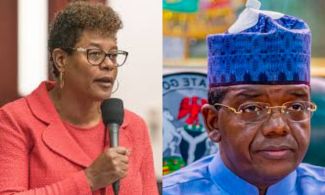
A member of the Florida House of Representatives, Kimberly Daniels, has publicly accused Nigeria’s Minister of State for Defence, Bello Matawalle, of attempting to bribe a United States lawmaker in a bid to counter reports alleging widespread killings of Christians in Nigeria.
Daniels, who also claims to chair the United World Congress of Diplomats, made the allegation during a live broadcast on social media, where she said she had been “backed into a corner” and was compelled to speak out.
According to her, the controversy stems from a report and press release issued by her organization, which described the killings in parts of Nigeria, particularly in northern regions, as “genocide against Christians.”
The claim aligns with longstanding but highly disputed narratives surrounding violence in the country, where attacks have been attributed to a mix of insurgency, banditry, and communal conflicts.
Daniels alleged that following the publication of the report, Matawalle attempted to influence an unnamed American state representative by offering financial inducement in exchange for publicly discrediting her claims.
“A US elected official was offered money by Nigeria’s minister of state for defence, Bello Matawalle, to change the narrative of the UN-WCD Christian genocide in Nigeria report,” she said.
She noted that “the minister offered money, any amount, to an elected official in the United States to counter what we published,” adding, “We have proof of the communication and materials sent.”
She further claimed that a promotional flyer and a letter purportedly originating from the Nigerian minister were circulated, seeking to portray him positively and dismiss the allegations as unfounded.
Daniels did not publicly release the alleged evidence during the broadcast but insisted it had been verified prior to her going public.
The Nigerian government has not officially responded to the bribery allegation at the time of filing this report. However, officials have consistently rejected claims of religiously targeted killings, maintaining that the country’s security challenges are complex and not driven solely by religious motives.
Nigeria has faced years of violence involving groups such as Boko Haram and Islamic State West Africa Province, alongside armed banditry and farmer-herder clashes. Analysts have repeatedly cautioned against framing the crisis exclusively as religious persecution, noting the interplay of ethnicity, land disputes, and weak governance.
Daniels, however, doubled down on her position, citing what she described as “ground-level investigations” conducted by the UNWCD across multiple countries, including Nigeria, Ghana, the United Kingdom, Canada, and the United States.
She also confirmed that the report had been forwarded to U.S. officials, including Marco Rubio, calling for further scrutiny and possible international attention.
Despite her allegations, Daniels acknowledged that the claims against Matawalle remain unproven and called for an independent investigation.
“I am not here to fight Nigeria or its government,” she said. “All I want is for these allegations to be investigated and for the killings to stop.”
Daniels earlier issued an assessment accusing elements within Nigeria’s security architecture of allegedly enabling attacks on Christian communities, particularly in the country’s troubled North-Central and North-West regions.
Daniels made the claims in a report released on April 14, 2026, following a wave of deadly attacks that coincided with the Easter celebrations.
The report paints a grim picture of escalating violence, alleging that worshippers were deliberately targeted during church services on Palm Sunday and Easter Sunday across Plateau, Kaduna and Nasarawa states.
According to Daniels, the pattern of attacks suggests more than random acts of violence.
She said, “What we are seeing is a brutal surge in violence that specifically targets religious congregations during their most sacred moments of worship.”
She added that while the administration of Bola Ahmed Tinubu had publicly condemned the killings, there appeared to be a troubling disconnect between official statements and the reality faced by vulnerable communities.
The report relied heavily on testimonies from local residents and survivors, many of whom expressed frustration and fear over what they described as a lack of protection.
One account cited in the document reads, “We hear statements from Abuja, but here, we bury our loved ones almost every week. There is no protection.” (SaharaReporters)