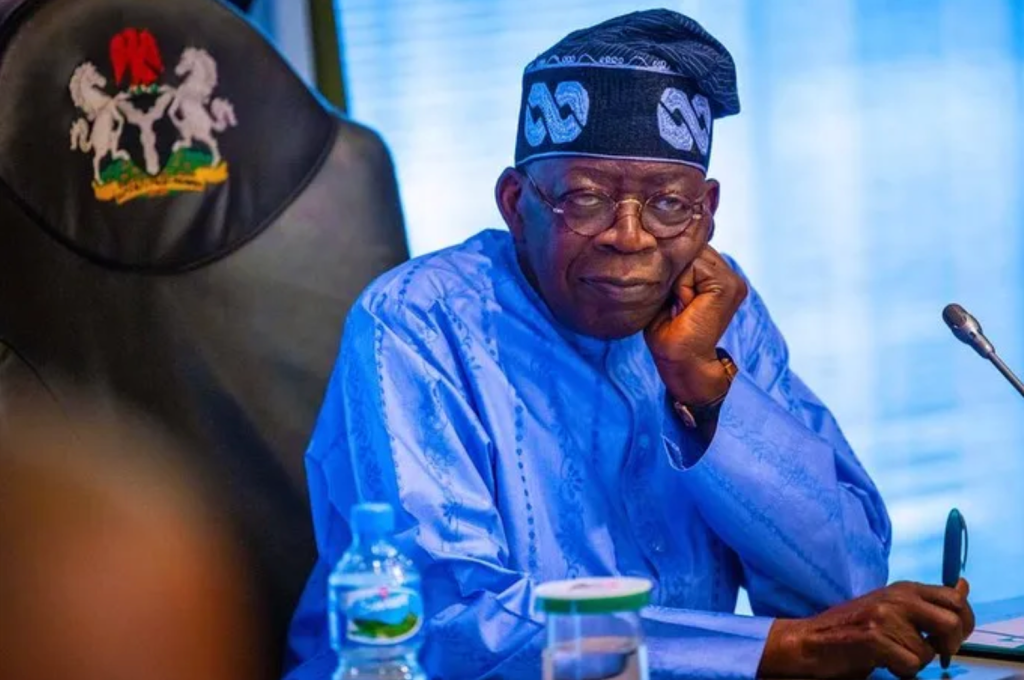
Professor of Petroleum Engineering, Izielen Agbon, has dismissed as “a scam” President Bola Tinubu’s claim of removal of fuel subsidy, querying what has happened to the savings which he stated the government had been unable to account for.
Speaking Wednesday evening on Channels Television programme, Politics Today, monitored by Newsmata.com.ng, Agbon contended that the country has continued to price petrol as though it has no crude oil despite being one of Africa’s major oil-producing nations.
The energy expert posited that Nigeria’s approach to petroleum pricing has historically relied on the wrong benchmark, saying the country should calculate the cost of petrol based on the cost of producing crude oil, refining it locally and transporting the finished product to consumers.
According to him, there are two major methods of pricing energy products, the production-cost method and the import-parity pricing method.
“You can start by looking at the price of petrol and say that it is the price of producing the crude oil plus the price of refining it to petrol plus the price of transporting it to the petrol station. That is called the production cost method,” Agbon said.
“You are using how much it costs you to produce the product and the profit.”
He explained that import-parity pricing, on the other hand, calculates what the product would cost if the country had no crude oil and had to import the finished petrol.
“Alternatively, the second method is you can assume that, well, supposing I do not have the crude oil and I have no crude oil at all and I’m just importing the petrol, how much will it cost me?” he said.
“If I’m just importing the petrol, then I’m going to use the fee. I’m going to import it – importing it to my port, clearing it and moving it to the petrol station. So this is the import parity pricing method.”
Agbon said oil-producing countries should ordinarily be able to use the production-cost approach because they have access to crude oil, while countries without crude reserves are more exposed to import costs.
He argued that Nigeria’s adoption of import-parity pricing effectively created an artificial “opportunity cost” which was later described as an implicit subsidy.
“What happened in Nigeria is this. The IMF came out and said that when Nigerian people, when we use the production cost method to price our PMS, what we are doing is we are losing the opportunity cost of importing it into our country,” he said.
“So, because of the opportunity cost angle, they reinterpreted the opportunity cost to say that it’s similar to us not having any petrol at all.”
He said the difference between the cost of producing petrol domestically and the hypothetical cost of importing it was subsequently treated as an implicit subsidy.
Agbon illustrated his argument with the example of a family that produces yam for its own consumption
“It’s like a family that produces yam and sells it in the market,” he said.
“If you sell yam in the market and get some money back to feed your family, but inside the family you are eating pounded yam, what you do is you produce your yam, you go and look for a pounded yam machine and you produce pounded yam in the house.
“You do not sell the yam in the market, get the money and take your family to a restaurant to go and buy pounded yam.”
According to him, such a family cannot reasonably be expected to charge its members the same price that a restaurant would charge for the same product.
“If you start producing pounded yam in your house, you cannot tell your children and your wife they must pay the price for the pounded yam as if they are buying it from a restaurant,” he said.
“So this is the fact. It is called comparative advantage in economics.”
Agbon said the solution to Nigeria’s petrol pricing problem lies in restoring the country’s refineries and using domestically produced crude to manufacture petrol for the Nigerian market.
“The way to achieve that is to repair our four refineries because that’s the big thing,” he said. He said Nigeria’s crude production cost is substantially below its international market value.
“And when we repair those four refineries, we now use the cost of producing a barrel of crude oil in Nigeria. I mean, a barrel of crude oil now sells for about $100 in the market, but it costs about $31 to $48 to produce a barrel of crude oil in Nigeria,” he said.
Agbon argued that once crude oil is refined locally and transported to filling stations, petrol could be priced according to the actual domestic cost of production rather than international import costs.
The professor also raised concerns over Nigeria’s growing dependence on Dangote Refinery, stressing that the commercial interests of a privately owned refinery are different from those of the Nigerian government.
“When you look at Dangote, you must understand that Dangote is a private entity whose primary interest is making profits and dividends for shareholders,” he said.
“What is good for Dangote is not necessarily what is good for the whole nation, because Dangote’s primary interest is to make a profit for its shareholders. On the other hand, the government’s interest is to provide safety for Nigerian citizens. They are completely two different things.”
Agbon said Dangote has become a major player in the Nigerian petrol market and argued that its pricing model could expose consumers to movements in the foreign exchange market.
“Dangote supplies 50% of the petrol in the country, and Dangote is the price setter,” he said.
He claimed that the refinery’s ex-factory pricing had a dollar component designed to protect the company against foreign-exchange volatility.
“So, if you are a marketer and you go to Dangote, the price at which you lift your petrol is $4.779 times whatever the exchange rate is. Although Dangote buys crude oil in Naira, in dealing with its products, petrol, it puts a dollar base price.”
He said this could result in fluctuations in the price of petrol depending on movements in the foreign exchange market.
“It can go up and down,” Agbon said.
Agbon also referred to a 1992 Central Bank of Nigeria study on petroleum product pricing and subsidies, which he said compared production-cost pricing with import-parity pricing
“In 1992, the CBN did a study on the determination of the pricing of petroleum products and subsidies,” he said.
According to him, the study examined the impact of both pricing methods and concluded that import-parity pricing could introduce instability into the wider Nigerian economy.
“He compared the import parity pricing method and the production cost pricing method and the different price of petrol it gives you,” Agbon said.
“And the CBN recommended that the import parity method would create a lot of instability because the price of petrol will affect the price of production, it will affect the price of transportation, it will affect the price of electricity, it will affect all other variables in the economy.”
He said the recommendation was that Nigeria should adopt the production-cost approach.
According to Agbon, Nigeria’s current pricing problem became more pronounced around 2000 when the Federal Government accepted an import-parityframework.
“Now, our problem started when in 2000, the Finance Minister now argued and accepted the IMF definition of price and insisted that the import parity method should be used,” he said.
He said the Petroleum Products Pricing Regulatory Agency (PPPRA) subsequently developed a pricing template based on the approach.
“This methodology argued that Nigeria has no petrol at all. How can we, an oil-producing country, start with a method of pricing based on the fact that Nigeria has no petrol at all? That is going to lead to our underdevelopment,” he said.
Agbon then questioned the Federal Government’s repeated references to savings generated by the removal of petrol subsidy under President Bola Tinubu.
“So, you see, this is a miracle,” he said.
“That’s why when the Tinubu government says there is competitive saving, the present Minister of Finance is not sure where the money has gone. Everybody is asking, where is this saving?”
The professor argued that the debate over subsidy removal should go beyond the government’s decision to end the policy and focus on how petroleum prices are calculated, the cost of domestic production and the destination of the funds previously spent on subsidy payments.
His comments come amid continued debate over the economic impact of the Tinubu administration’s decision to remove petrol subsidy, with the government maintaining that the policy has freed up funds for other areas of public spending.
Agbon, however, argued that Nigeria’s approach would continue to expose consumers to high petrol prices unless the country develops sufficient domestic refining capacity and uses production-cost pricing.
‘NNPC Should Be Supplier Of Last Resort’
The professor also called for functional government-owned refineries that can provide a competitive alternative to private-sector suppliers.
“You need state-owned government refineries that are run productively so that NNPC can become the supplier of petrol of last resort,” he said.
“And it is the NNPC that sets the minimum price based on production cost.”
Agbon acknowledged that Dangote, as a private company, would naturally pursue its commercial interests.
“Dangote is private. Dangote can do whatever Dangote wants to do,”
“It is a private business. But when we are talking of Nigerian development, it is the government that should do it.”
He therefore argued that Nigeria’s long-term energy policy should prioritise functional public refineries, domestic crude processing and a pricing mechanism based on the actual cost of producing petroleum products in the country.