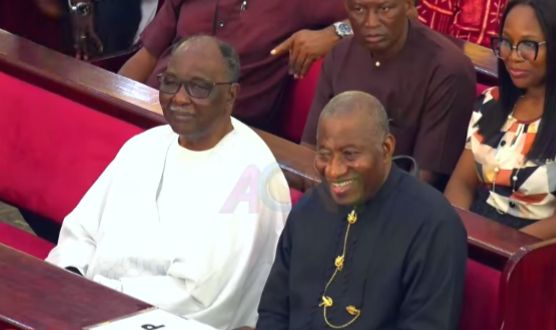
Amidst frantic attempts to draft former President Goodluck Ebele Jonathan into the 2027 presidential race by some pressure groups, Primate of the Church of Nigeria, Anglican Communion, The Most Reverend (Dr.) Henry Ndukuba has advised him not to succumb but to continue to be the senior citizen that he should be.
Newsmata.com.ng reports Archbishop Ndukuba gave the advice on Saturday in his State of the Nation address, at the 13th Synod of the Diocese of Abuja held at St James Anglican Church, Asokoro, Abuja.
Cautioning Jonathan against joining the race to retain his good name and role model status, which he noted is more relevant across the globe, the Anglican Primate declared that “We don’t want you to spoil that good name. And please, keep off for now; let them just play it. Be the senior citizen that you should be.
“We thank God for your life, not only for Nigeria but for the West African region, ECOWAS and Africa.
“You are a symbol that should stand. You are a hope for our generation that it is possible for us to be civil, to lead with integrity, and possible for us to pass on a worthy legacy to those coming after us”.
Ndukuba lamented that worsening hardship and political manoeuvring ahead of the 2027 general elections were distracting leaders from governance and deepening public frustration.
According to him, “It is clear that the political class is jostling for its survival rather than the service and welfare of the people. Our political leaders have abandoned governance to pursue their strategy for contesting the 2027 elections.”
Ndukuba noted that the wave of defections across political parties, the absence of strong opposition politics and increasing “toxic political manoeuvres”, showed that many politicians were more interested in power struggles than solving the country’s economic and security problems.
He appealed to the leadership of the Independent National Electoral Commission (INEC) to remain neutral, ensure fairness in the electoral process, and provide a level playing ground for all to participate ahead of 2027.
On insecurity, Ndukuba said Nigeria was “bleeding,” adding that “the genocide against the citizens of Nigeria is evident, especially against Christian communities in the North and some Southern States.”
The Primate faulted attempts to describe attacks as communal clashes or farmer-herder conflicts, insisting that religious extremism, expansionist agendas and criminal control of mineral resources were major drivers of insecurity.
“The propaganda and play of words for political correctness before the international community is a disservice to Nigerians,” he added.
Ndukuba called for sustained military offensives against criminal groups, improved support for local vigilantes and stricter prosecution of sponsors of violence, while also raising concern over growing drug trafficking and addiction.
He warned that Nigeria was gradually moving from being a transit route to becoming a major player in the narcotics trade. In addition, he lamented that cultism, ritual killings and gang violence among young people were spreading across schools and communities, posing fresh threats to national stability.
Also addressing the gathering comprising bishops, delegates and worshippers at the Synod, Jonathan said although the country was passing through a difficult phase, he remained convinced that with prayers and good leadership, Nigeria would emerge stronger.
He said, “We are in a society that the Church has a lot of work to do, but I believe as a country, we will get over our challenges. God will not abandon Nigeria.”
Jonathan said the rebuilding of the country would require discipline, patience and committed leadership, drawing parallels with Asian countries that took decades to attain economic transformation.
According to him, “When I became Vice President, I used to wonder how Asian Tigers moved from third world to first world.
“It took between 30 and 40 years for some countries to move from where we are now to near first world status. Progress takes time, good and focused leadership, and commitment.”
The former president also raised the alarm over what he described as growing moral decay and violence in the society, warning that the conduct of young people and the erosion of social values had become a source of concern.
“What is happening in our society, the way we push ourselves, the way we treat ourselves, society has become so complex that sometimes we don’t even know where we are going,” he said.
Jonathan said religious leaders had continued to play a stabilising role in the country through prayers and moral guidance, adding that “If religious leaders had not been praying seriously for this country, probably it would have been worse than what we are seeing today.”
He lamented increasing violence among young people, saying the social environment had changed drastically from what obtained in previous decades.
“These days, a young person will pick a gun, go into a classroom and kill another student, and everything goes on normally.
“When we were in school, most students died natural deaths. But today, the situation is different,” he lamented.
Jonathan also warned about the influence of social media on children and youths, saying, “young people are overexposed. They tend to look more at the bad things than the good ones.
“Even our children in primary schools continue to imitate what they see,” he stated regrettably.