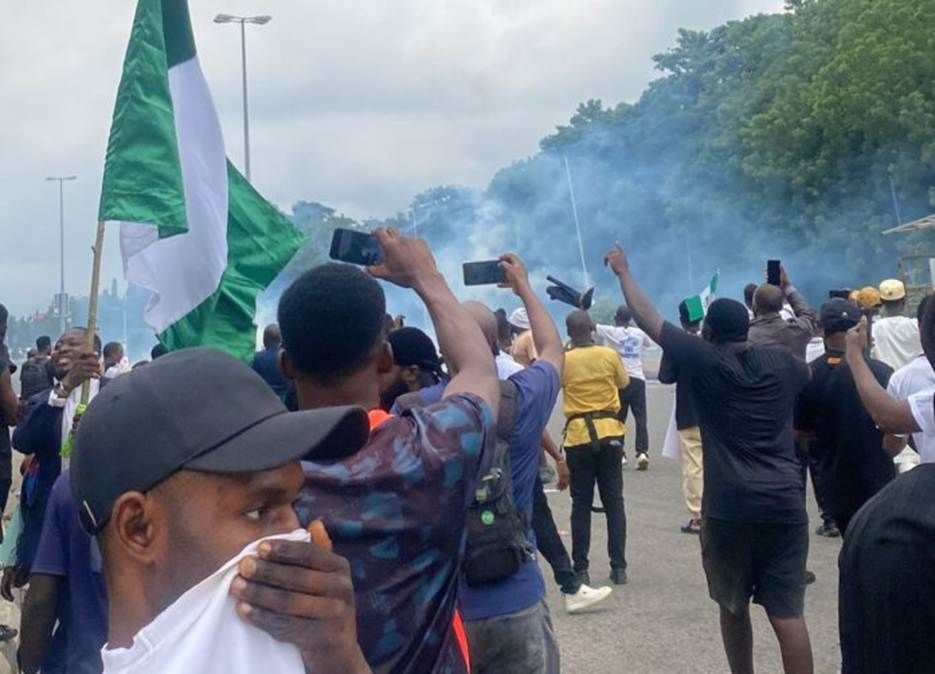
Protesters covering their face/ ICIR
THE August 2024 nationwide protest over economic hardship and policies introduced by President Bola Tinubu was met with a security crackdown, leading to arrests across the country. This report digs into how the National Intelligence Agency (NIA) worked with the police to track, monitor, and arrest some activists linked to the protests, actions that led to their arraignment on treason charges.
In the early hours of August 5, 2024, armed operatives stormed the Abuja home of Michael Adaramoye, one of the activists later charged with treason following nationwide demonstrations against economic hardship.
The operatives, who would later be identified as members of the National Intelligence Agency, NIA, arrived in several vehicles with their faces masked.
Within seconds of seizing Adaramoye’s phone, one officer handed it to a colleague who briefly inspected it before returning with a confirmation: “This is the target.”
According to Adaramoye, the officers already had detailed knowledge of his phone calls, contacts, and movements. During interrogation, they recounted conversations he had held days earlier and referenced people who had contacted him, suggesting his phone communications had been tracked or intercepted before the arrest.
Adaramoye would later spend 28 days in police detention and 34 days in Kuje Correctional Centre under harsh and degrading conditions. He is among 10 activists accused of treason and terrorism in connection with the 2024 #EndBadGovernance protests – charges rights groups say reflect a broader pattern of criminalising dissent.
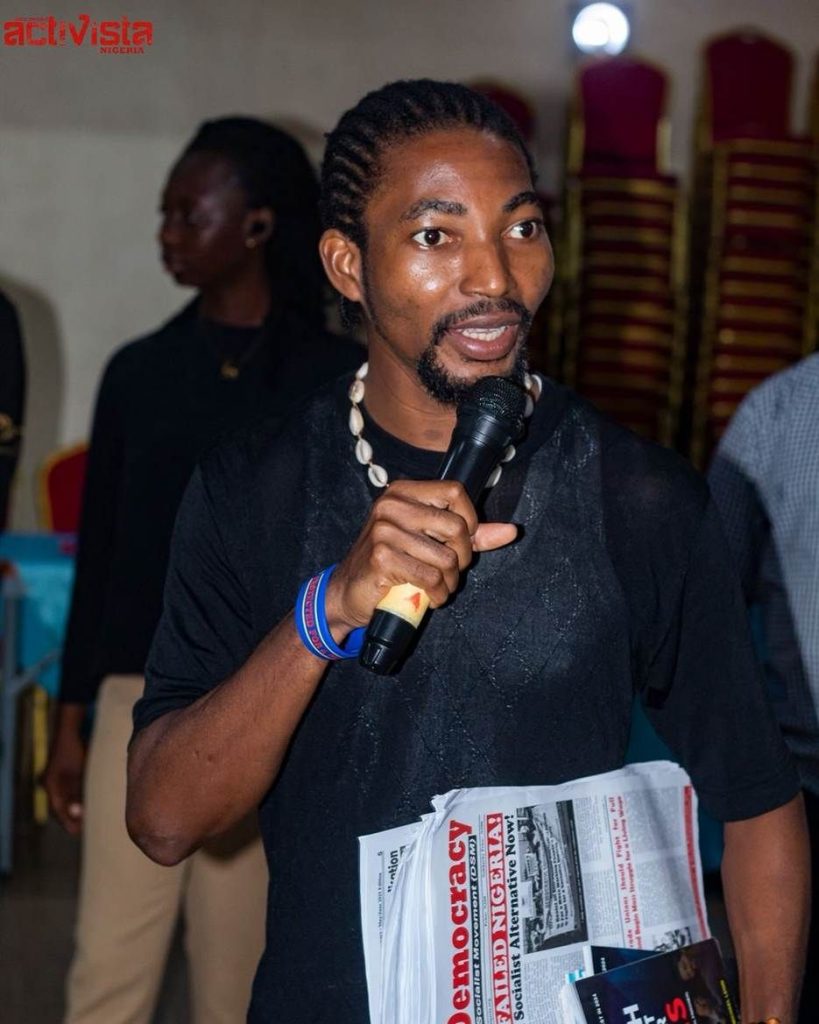
Michael Adaramoye Lenin
His experience also points to a wider, largely opaque system of digital surveillance allegedly deployed by security agencies to monitor, track, and detain activists.
He is one of many Nigerians arrested across the Federal Capital Territory (FCT), Kano, Sokoto, and other parts of the country during the crackdown that followed the protests. Civil society organisations estimate that over 1,000 people, many of them young Nigerians, including minors, were detained, with reports of arbitrary arrests, enforced disappearances, and prolonged detention without trial.
The #EndBadGovernance movement, which gained momentum in early August 2024, emerged as a nationwide expression of frustration over worsening economic hardship, inflation, fuel subsidy removal, and rising insecurity. What began as largely peaceful demonstrations demanding accountability and relief measures quickly escalated into a heavy-handed state response. For many families, the protests have since translated into prolonged trauma, with loved ones held in custody for days.
Nigeria’s investment in ‘dangerous’ surveillance technology
Over the past decade, Nigeria has quietly built a vast digital surveillance infrastructure. Research shows the government spent at least $2.7 billion on surveillance technologies between 2013 and 2022, including tools capable of intercepting calls, social media messages, and other communications, which legal experts and activists say might have been used in a crackdown on civic space.
Data obtained from UN Comtrade shows that Nigeria imported surveillance equipment worth $6.61 billion between 2015 and 2024, with annual imports peaking at $826.8 million in 2019 before falling to $469.6 million in 2024.
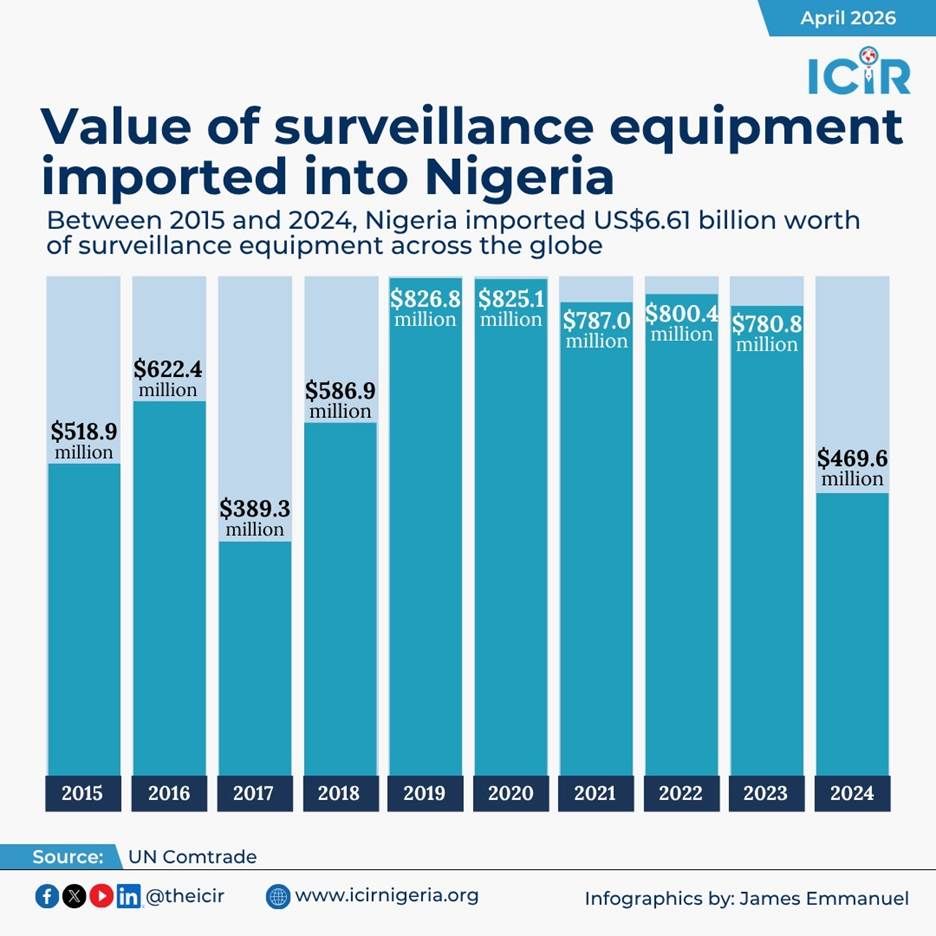
Value of surveillance equipment imported into Nigeria
In 2021, the National Assembly approved a total of N4.86 billion for the NIA to purchase equipment to spy on and monitor Nigerians’ WhatsApp messages, phone calls, and text messages.
A breakdown of the amount shows that N1.93 billion was earmarked for a ‘WhatsApp Intercept Solution,’ while N2.93 billion was for a ‘Thuraya Interception Solution,’ a communications system used for monitoring voice calls, call-related information, short message service (SMS), and data traffic, among others.
According to a report by the University of Toronto’s Citizen Lab which researches digital surveillance, security, privacy, and accountability, Nigeria’s Defence Intelligence Agency (DIA) also acquired multimillion-dollar equipment it could use to spy on calls and text messages.
The report, Running in Circles: Uncovering the Clients of Cyber-espionage Firm Circles, reveals that a telecom surveillance company known as Circles has assisted state security agencies in over 25 countries, including Nigeria, to monitor the communications of opposition figures, journalists, and protesters.
According to Citizen Lab, Circles is linked to the Tel Aviv-based NSO Group, widely known for its Pegasus spyware. Governments have reportedly deployed Pegasus to spy on dissidents by infiltrating smartphones, accessing cameras and microphones, and extracting sensitive personal data.
Unlike Pegasus, Circles’ technology exploits vulnerabilities in the global telecom system known as Signalling System 7 (SS7) – a protocol that enables communication between mobile networks. This method allows surveillance without leaving obvious traces on a target’s device, making it significantly harder to detect.
Findings from the report further indicate that Nigeria is among the countries where Circles’ tools have been deployed. Specifically, the Defence Intelligence Agency is identified as one of at least two Nigerian entities using the system, whose network infrastructure was linked to Circles-related activity.
Tracked, detained, and slapped with frivolous suits
Days before his arrest, Adaramoye had noticed a subtle signal that was almost easy to dismiss.
He recalled receiving a phone call from a man who introduced himself in the language of activism. The caller sounded like a fellow organiser, curious about the planned protests, eager to connect, and willing to meet. At first, nothing seemed out of place. As a known activist, Adaramoye’s number was widely accessible, often shared within civic circles.
But something about the conversation felt off.
“The way he was speaking, I knew he was from a security agency,” Adaramoye said. “It was an attempt to lure me.”
The caller had asked to meet in person, a request Adaramoye declined. He would later come to believe that the call was not just a casual probe, but part of a calculated effort to locate and apprehend him ahead of the protests. That encounter, as brief as it was, marked what he now considers his first direct brush with covert surveillance tied to his eventual arrest.
That suspicion only deepened during his detention.
For hours, interrogators spoke with striking familiarity about his private life. They listed recent calls he had made, identified people he had been in contact with, and referenced conversations he barely remembered.
“They were telling me who called me, what we discussed,” he said. “They even tracked my location.”
To Adaramoye, it suggested that his phone had been compromised, either through direct interception or more sophisticated surveillance tools capable of accessing call logs, messages, and possibly real-time location data.
Yet, despite this apparent depth of access, he insists nothing incriminating was found.
“They had everything for about a week,” he said. “But there was nothing criminal they could point to.”
When the case transitioned from intelligence custody to a police-led investigation, the alleged digital evidence disappeared from the narrative. In court, prosecutors relied instead on broad allegations of treason, terrorism, and mutiny without presenting any of the detailed communications that had formed the basis of his interrogation.
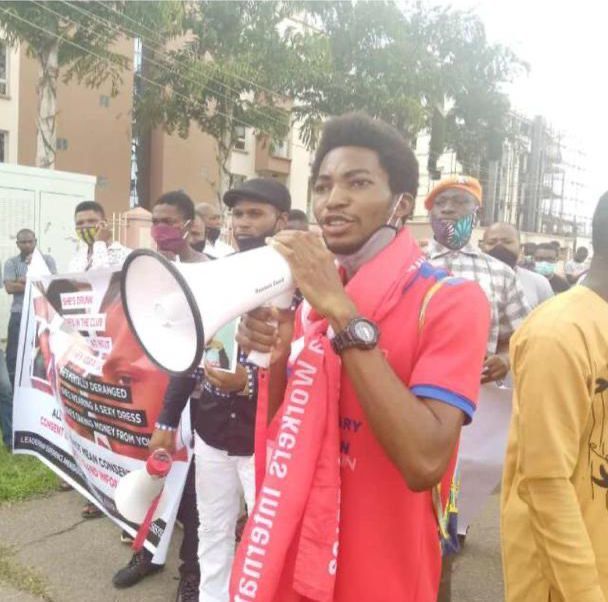
Michael Adaramoye on the protest ground
Adaramoye was not the only one who believed surveillance played a role in the arrests. Another activist picked up in the same operation, Babatunde Sankara, told The ICIR that, from the pattern of events, he suspected they were being tracked by the NIA before the raid.
“They were able to track him through his phone. That’s how they were able to locate us, even though I wasn’t their primary target,” Sankara said.
According to him, there were warning signs in the days leading up to the arrest. Unknown individuals had reportedly been making inquiries about them within the estate, while there had also been earlier attempts to lure Adaramoye.
“We were informed by the estate security that some people had been going around asking about us. Secondly, there had been previous efforts to lure Lenin (Adaramoye). Given my experience in activism, that’s one of their tactics. Third, we knew they had the facility to track phones and that’s how we knew we were under surveillance,” he said.
Those suspicions would soon give way to a dramatic raid which occurred when Sankara and two others were fast asleep around 2 a.m. and were jolted awake by heavy banging on the door and the sound of boots moving through the two-storey building in Abuja. The operatives first stormed the upper floor, searching for their target, before descending and pounding on Sankara’s door.
Half-awake and disoriented, he initially thought they were kidnappers.
It was only when they began asking for Michael Adaramoye that he realised they were security operatives. Once Adaramoye identified himself, the officers ordered him aside, searched the room, and quickly moved to take him away. But Sankara’s insistence on knowing where he was being taken drew him into the operation.
Even though he was not directly involved in the protest, he was also arrested.
“They came in through the back gate, and that’s also where they took us out. We had already left when they got a call to go back and pick the others,” Sankara said.
Blindfolded and disoriented, they were driven around for nearly an hour, far longer than the 15-minute journey Sankara said it should have taken, before arriving at the facility of the National Intelligence Agency.
At the facility, Sankara said they were subjected to harsh conditions. He spent over several hours blindfolded in what he described as a freezing “cold room,” with his leg cuffed, while his requests for medication for his diabetes were ignored. At one point, when he asked that his handcuffs be placed in front due to his condition, an officer responded with violence.
The interrogation, he added, continued without access to legal representation before they were eventually transferred to the police for further investigation.
“Even in the days of the military, security operatives don’t come at odd hours, blindfold people and whisk them away. It is a major disaster that this is happening under the democracy we fought for,” he said.
“It is a shame that they have this technology and cannot use it to trace kidnappers, bandits, or terrorists, but are instead using it to hound innocent citizens. Digital rights are being abused, and even the laws meant to protect those rights are being violated.”
Sankara was released three days after his arrest, on Thursday, August 8. However, Adaramoye and Mosiu Sadiq, another activist also nabbed by the NIA, spent 28 days at the IRT before eventually arraigned.
Alongside eight others linked to the #EndBadGovernance protests, they were arraigned on September 2 by the Nigerian government on six-count charges bordering on alleged attempts to topple President Bola Tinubu, felony, and cybercrime. The 10 individuals were accused of being sponsored by Briton Wynne who has since been declared wanted by the police for allegedly funding a plot to overthrow President Tinubu and for waving Russian flags in some parts of the country.
Wynne, whose bookshop was raided by police at the Nigeria Labour Congress (NLC) headquarters in Abuja during the protests, has denied all allegations.
For 28 days, Adaramoye and Sadiq were held in an underground cell reportedly housing no fewer than 40 inmates. During the first three days of their detention at the IRT, both men were starved and denied medication.
For the first three days of their detention, Adaramoye and Sadiq were denied food and survived only on water. The harsh conditions took a toll on Sadiq’s health, as he fell ill, likely due to prolonged exposure to cold and the unsanitary environment of the detention facility. Despite informing officers of his condition through Adaramoye, he received no immediate medical attention and endured the illness for weeks until a fellow detainee, a police officer, eventually helped him with medication.
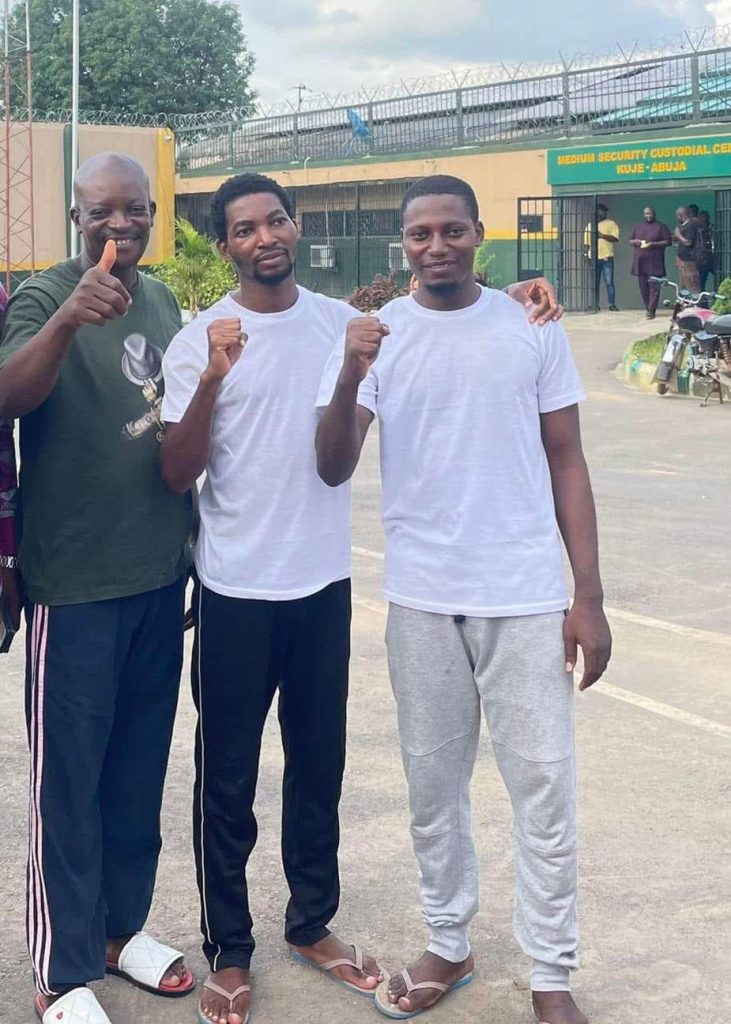
From Left: Mosiu Sadiq, Michael Adaramoye and Eleojo Simon after release from Kuje Prison. Source: Omoyele Sowore
Throughout their detention, Sadiq said he faced repeated pressure from investigators to confess to alleged crimes, including designing protest materials. He maintained his innocence, insisting that no incriminating evidence was found on his seized devices and that he had not participated in the protests. Nevertheless, he was still charged with serious offences, including treason.
After 28 days in detention, Sadiq, Adaramoye, and others were transferred to the Kuje Correctional Centre. While conditions there were somewhat better, they remained difficult, with overcrowding and poor sanitation leading to rashes and infections. The experience, Sadiq said, left him mentally distressed and deeply shaken.
On September 11, 2024, they were granted bail “in the sum of N10m each and one surety in like sum”. The trial judge added that the sureties must be residents of Abuja and must own properties in the nation’s capital. Their documents were to be deposited with the court registrar, in addition to swearing to an affidavit of means. Even though they were subsequently acquitted after 16 months of legal battle, the experience continues to live with them.
Digital surveillance and rights violations
There have been growing concerns over the use of digital surveillance in Nigeria and how such tools, if left unchecked, could be used to violate citizens’ right to privacy, monitor private communications, and suppress dissent. For many activists and legal observers, the issue is not just the existence of surveillance technology, but the opacity surrounding how, when, and against whom it is deployed.
Marvellous Ini-Obong Monday, a legal associate with Citizens’ Gavel Foundation for Social Justice, said the deployment of surveillance tools to track activists and suppress dissent directly threatens constitutionally guaranteed freedoms.
“The Nigerian Constitution explicitly guarantees and protects the privacy of citizens, their homes, correspondence, telephone conversations and telegraphic communications. Surveillance of activists’ phone calls, messages and location data without proper legal authority directly contravenes this provision,” he said.
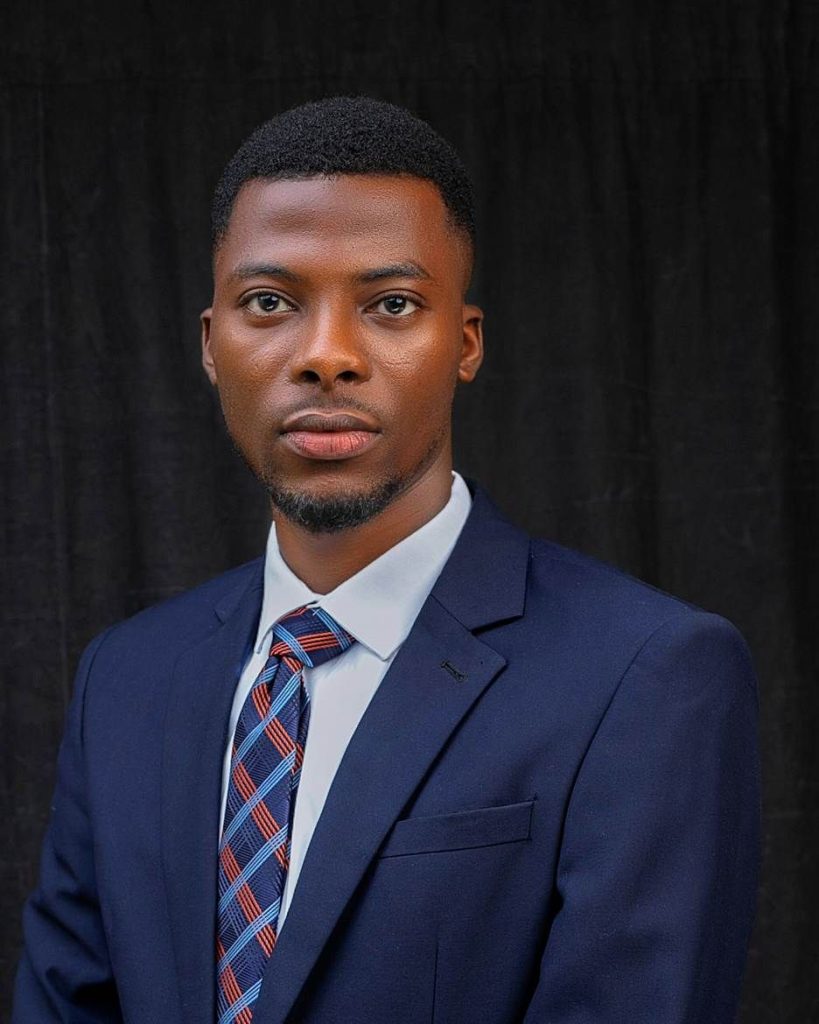
Marvellous Monday
Monday explained that beyond the right to privacy, such actions could have a broader chilling effect on civic participation.
“When activists know their communications are being monitored, they may self-censor, avoid organising protests or refrain from associating with certain groups and these effectively curtail these constitutional rights,” he said.
He noted that although Nigeria has multiple legal frameworks regulating surveillance, including the 1999 Constitution, the Cybercrimes (Prohibition, Prevention, etc.) Act 2015, the Nigeria Data Protection Act 2023, and the Nigerian Communications Act 2003, there are still significant gaps in how these laws are applied, particularly with newer surveillance technologies.
Monday pointed to the Lawful Interception of Communications Regulations (LICR) 2019 as a major source of concern, noting that some of its provisions appear to grant sweeping powers to security agencies.
“Regulations 4 and 8 of the LICR give agencies a near-blanket authority to intercept communications, seemingly without any requirement to first demonstrate a link to a specific crime or threat to national security,” he said.
According to him, these provisions conflict with Section 37 of the Constitution and should be struck down, stressing that while Section 45 allows certain restrictions on fundamental rights, such limitations must be reasonably justifiable in a democratic society.
On the legal thresholds required for surveillance, Monday said agencies such as the National Intelligence Agency are bound by both constitutional and statutory requirements, including the need for lawful justification and, in many cases, judicial authorisation.
“The fundamental principle is that no agency has the right to monitor private communications without lawful justification,” he said, adding that while Section 38 of the Cybercrimes Act allows access to subscriber data, Section 39 requires a court order before interception or recording of communications.
He stressed that mere participation in protests or expression of dissenting views does not constitute grounds for surveillance, warning that targeting activists, journalists, or critics simply for exercising their rights would amount to a violation of fundamental human rights.
Also speaking, Muhammed Bello Buhari, a digital rights activist and Programme Officer for Anglophone West Africa at Paradigm Initiative (PIN), said the impact of surveillance extends beyond legal violations to a broader erosion of civic space.
“If we’re talking about the long-term impact of spying on activists and journalists in Nigeria, the biggest casualty is trust, which immediately creates a massive chilling effect,” he said.
“Imagine knowing, or even just suspecting, that security agencies are reading your WhatsApp messages or tapping your calls. People naturally start to self-censor. They stop organising peaceful protests, they stop speaking out on social media, and the civic space just paralyses.”
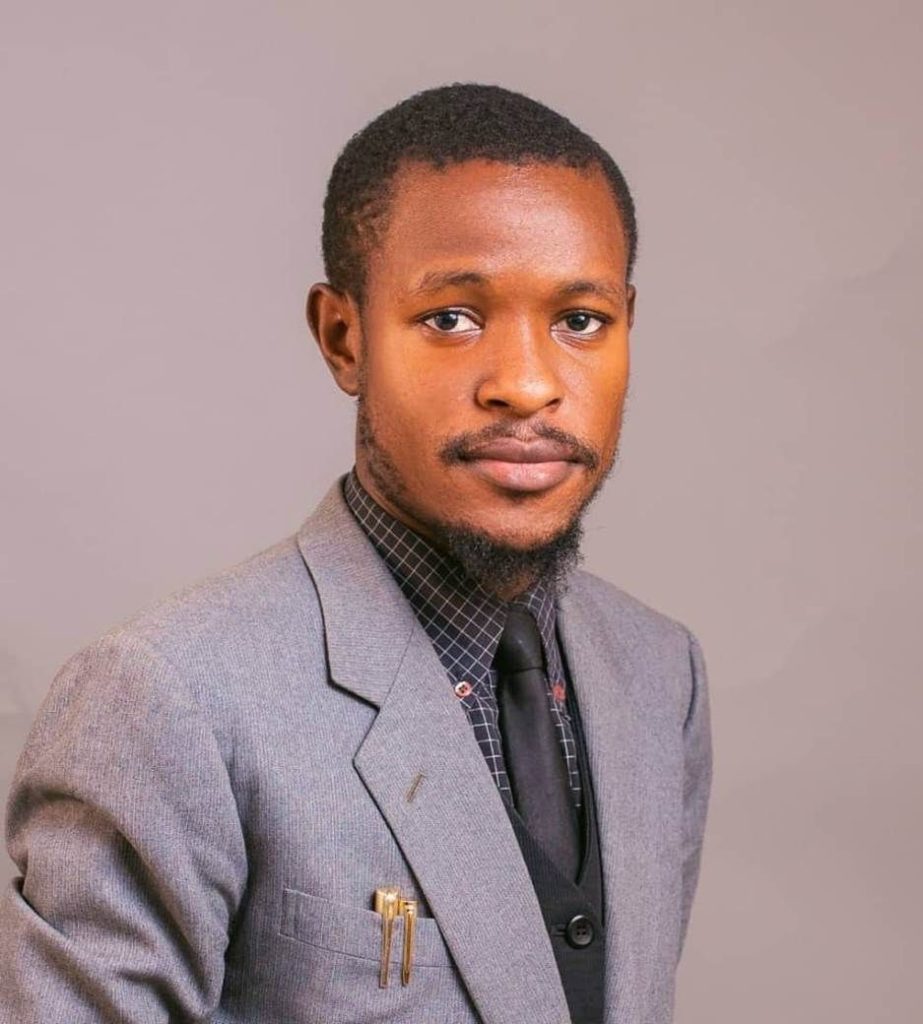
Mohammed Buhari
He added that the implications for journalism are particularly severe, as surveillance undermines the confidentiality that investigative reporting depends on.
“Investigative reporting relies entirely on whistleblowers and confidential sources. But if a source knows that the DSS or the police can easily use telecommunications data to unmask them, they simply won’t leak that story about corruption or human rights abuses,” he said.
On the adequacy of Nigeria’s legal safeguards, Buhari said existing frameworks fall short in practice, largely due to broad national security justifications.
“People in government will point to the Data Protection Act or the Cybercrimes Act, but there’s a giant loophole: the ‘national security’ clause. Security agencies use that vague phrase to bypass standard privacy protections, often without any real, independent judicial scrutiny,” he said.
He called for stricter safeguards, including mandatory judicial oversight for all surveillance activities and greater transparency in the procurement of surveillance technologies.
“Surveillance should never be an administrative decision made behind closed doors. Agencies must obtain a specific, time-bound warrant from a court based on probable cause,” he said.
Buhari also stressed the need for public accountability in how surveillance tools are acquired and deployed.
“Right now, the procurement of surveillance technology is largely opaque. There should be legislative and civil society oversight to ensure these tools are not weaponised against citizens,” he added.
He noted that efforts such as the proposed Digital Rights and Freedom Bill are aimed at addressing these gaps by establishing clearer legal boundaries for surveillance and strengthening protections for citizens’ data and freedoms.
(Nurudeen AKEWUSHOLA/ICIR)