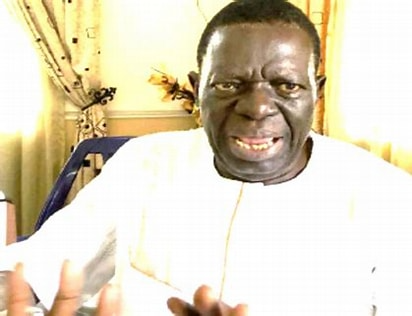
Ex-IGP Kayode Egbetokun
The controversial tenure of Nigeria’s Inspector General of Police, Kayode Egbetokun ended abruptly on Tuesday following his sack by President Bola Ahmed Tiinubu who replaced him Tunji Disu, the Assistant Inspector General of Police overseeing the Force Criminal Investigation Department (FCID) Annex in Alagbon, Lagos.
Informed sources say Egbetokun, who was at the Presidential Villa yesterday at the behest of President Tinubu, was directed to prepare his handover notes and tender his resignation.
Following the firing of Egbetokun, inside police sources say about 30 senior police officers, including some Deputy Inspectors General of Police (DIGs) and Assistant Inspectors General of Police (AIGs) may have to go on compulsory retirement.
Newsmata.com.ng reports that Egbetokun was appointed as the 22nd IGP on June 19, 2023, by President Tinubu, while his appointment was confirmed by the Nigeria Police Council on October 31, 2023.
He took over from Usman Alkali Baba who was appointed by then President Muhammadu Buhari on April 6, 2021, and his appointment confirmed as the substantive IGP on June 4, 2021, by the Police Council. Though he was due for retirement March 1, 2023, after attaining the mandatory 60 years retirement age, his tenure was controversially extended by the president in January 2023.
The extension was however challenged in court by Okechukwu Nwafor with the Federal High Court sitting in Awka, Anambra State, presided over by Justice Fatum Riman declaring Alkali Baba as an “illegal occupant” of the seat.
The court ruled that “despite the prerogative power of the President, he is limited to the provisions of the Constitution. The Inspector General of Police retirement is a statutory and constitutional issue and no other law of the land can change the ground norm.”
Justice Riman said Buhari’s extension of IGP Baba’s tenure violated the provisions of the Police Act 2020.
According to the judge, “It is important to observe that the Inspector-General of police is a public servant and by virtue of the fact that he is a member of the staff of the Nigeria Police Force, an authority established from the Federation by Section 214 (1) of the Constitution and in the subject of the Federal Public Rules 299 (PSR) thereof which provides for the compulsory retirement of all grades of public service officers at the age of 60 or 35 years of service, whichever comes first”.
Like his predecessor, Egbetokun, who came into office at the age of 58, ought to quit on September 4, 2024, upon reaching the mandatory retirement age of 60. But his tenure was controversially extended by the President.
Taking a cue from the ex-IGP Alkali Baba’s experience, President Tinubu pushed for the amendment of the Police Act 2020 to legitimise the extension of Egbetokun’s tenure.
Though no official reason had been given for his sudden removal, sources who should know say it may not be unconnected to many controversies and scandals that had dogged his tenure which seemed to question his professionalism and efficiency.
SaharaReporters, for example, reported how one Bukola Yemisi Kuti, a Principal Staff Officer to Egbetokun, received rapid promotions under questionable circumstances.
Critics alleged that her closeness to the IGP gave her undue advantage, fueling perceptions of favoritism and nepotism within the police force.
The online news media also reported how ₦100 million from Anambra State’s security vote was allegedly traced to the account of Victor, Egbetokun’s son.
The claim sparked significant controversy, as it raised concerns about the possible diversion of state security funds and the alleged personal benefit to the Inspector-General’s family.
Rather than allowing an independent investigation into the matter, police authorities were said to have deployed institutional resources to pursue legal action against individuals and platforms reporting on the allegations, further fueling suspicions of corruption and abuse of office.
The ex-IGP’s tenure was also characterised by multiple lawsuits against journalists and activists, particularly Omoyele Sowore, publishers of SaharaReporters who labelled him an “illegal IGP” following the controversial extension of his tenure by Tinubu.
Recall that the Federal High Court recently issued injunctions restricting further publications concerning Egbetokun and members of his family as well as Bukola Kuti.
Discerning minds perceive this as trying to shield Egbetokun from further public scrutiny of his actions or inactions as a public servant and the nation’s number one law enfoorcement officer.